Monday, 9 January 2012

The Arctic - A "Miner's Canary"?

So then,

What has this got to do with me? Should I be worried?

It would be easy to get sentimental here by saying something like 'we're all citizens of this planet' etc etc, but I'll resist... for the time being! Basically, it matters to all of us because of the significance the Arctic is likely to have in the context of climate change during the coming decades. Although I've repeated it so many times during this blog, I'll say again that the Arctic is warming faster than any other area on the planet. The sea ice record is especially sensitive to temperature, and it has been reacting to the change at a remarkable rate, as we've seen.

In most of the world, biological responses to climate change cannot easily be separated from other things such as habitat loss and land use change, impacts which are potentially more severe. As the Arctic is far way from major populations, it gives an opportunity to see the impacts of climate change clearly, as these other factors are minimal (see assessment of pollution as a factor). Also, ecotones surrounding the Arctic are extremely sensitive as they lie on the very edge of possible habitation, meaning vegetation shifts have become apparent.

Therefore, it could be said that the changes seen in the Arctic over the last few decades are a warning sign, a miner's canary which is showing the first signs that it isn't feeling too great. It's showing signs of a relatively weak (in the context of land use changes etc in other areas) but persistent and growing force. If left alone, the potential for positive feedbacks through melting permafrost and ocean albedo effects would take the path of warming completely out of our hands. If that happens, we definitely should be worried.

As well as this, the political implications of what is happening in the Arctic may be even more pressing and potentially damaging. Tensions are already building between Arctic, and even non-Arctic nations about the resource scramble which is likely to happen now that new areas suitable for resource prospecting have been opened up. In an often cited example, in 2007 Russia planted a 1m high flag under the north pole in a symbolic move to lay their claim to resource rights in the Arctic. Of course, this significantly added to the tension surrounding the Arctic and geopolitics.
Russian flag planting mission, a global superpower laying it's claim to the billions of dollars
worth of resources beneath the Arctic.
Whether they like it or not, the environment is now an issue policy makers must act on. It will be interesting to see how things pan out from here in the Arctic. Hopefully some lessons will be learned, meaning climate change doesn't become an opportunity for further environmental damage. It should be clear then, that although the Arctic is out of sight, it would be unwise to put it out of our minds.
____________________

As a final comment, I hope during the course of this blog I've managed to objectively comment upon the changes in

Sunday, 8 January 2012

Wrapping up (2)

This is the penultimate post! (please, don't cheer too loudly). For the second half of the review (click here for the first part), I'm going to briefly consider some of the more tricky questions about the Arctic about the future. Of course, any answers are only based on past experience. It's impossible to tell what path environmental change in the Arctic will take, especially with the added complication of people who are even more unpredictable than the environment. So, here goes...

What is the likely impact of future human activity on aquatic and terrestrial arctic ecosystems?

It's only possible to extrapolate from what we know, meaning it's likely the changes seen in the past few decades are likely to continue. Also, natural systems exhibit lagged responses, especially when organisms take decades to grow. For example, shifts seen in aquatic ecosystems are very significant as they respond quickly to temperatures. Alterations to terrestrial vegetation, on the other hand, are slow, meaning the small changes evident in the past few years are probably responses to warming a few decades ago. Therefore, it's likely that aquatic communities will continue to shift with changing patterns of ice cover and benthic vegetation, woody (and perhaps even large vascular plants) will expand in extent, permafrost will melt and temperate organisms will begin to move north.

This is also a good point to bring up all the papers which I haven't had time to bring up, but indicate the potential for future changes in the Arctic as extrapolated from that seen in recent decades. In a great review article, Post et al. (2009) provided a short account of ecological responses to Climate Change in the Arctic. Changes with significant potential include range shifts (seen in moths), invasive species and phenology (see graph below).
Earlier flowering in Greenland (direct from Post et al., 2009)
Such movements in seasonality become problematic when there's a mismatch between producers and consumers. For example, a growing difference was observed between peak Caribou births and peak productivity of

Thursday, 5 January 2012

Google Insights

Came across this on the internet the other day and thought it was a great way to illustrate, albeit unscientifically, broad patterns in the public consciousness. Google insights allows you to plot the daily number of web searches for a particular search term through time (plotted as a function of total searches, explained here if you're interested). As an example, here's the worldwide results for terms including 'London 2012':


There's a clear peak during summer 2005, when the games were awarded to London, and in summer 2008 during the Beijing Olympics. It's also evident that interest has been growing during 2011 as the games approach. Clearly, worldwide search terms often match up to real events, and give an indication of what's in the public awareness. So, let's apply this to the Arctic.

Starting off simply, here's the record for 'Arctic' under the science category ('all subjects' just returns loads of stuff about the Arctic Monkeys).


There's a couple of things to notice here. Firstly, interest in the Arctic during the past two years seems to have waned, especially when compared to 2004 and 2005. Also, searches increase clearly during the Northern

Tuesday, 3 January 2012

Wrapping up (1)

Unfortunately, it's almost time for this blog to come to an end, so for the last couple of posts I'll try and sum up what I've learned over the course of the past couple of months. At the beginning I posted a few questions that I wanted to answer, so I think these are a good place to start, so I'll use these as a structure for the next couple of posts.

How do we know the sea ice retreat in the past few years is unusual?

The blog started off by looking at this question, firstly by using satellite data. Since satellite data began in 1979, sea ice extent and thickness have been decreasing at an alarming rate. Sea-ice extent during the summer of 2011 (sept) was almost on par with the previous record low during 2007, even without the unusual weather patterns thought responsible for the 2007 low. This strongly suggests that even though sea ice doesn't decrease every winter, overall conditions are worsening for continued survival of permanent sea ice.

A number of proxy records show a sea-ice history going further back than any contemporary records. As part of the blog, I looked at two relatively new methods of constructing these histories; the IP25 biomarker and Quartz records. These, as well as other methods, including documentary and ice-diatom records, show that extent of sea ice has been strongly variable, but also strongly correlated with climate. Sea ice extent is therefore extremely sensitive to temperature changes, meaning if we were experiencing global warming today, we could expect a significant loss of sea ice. Is that what we've been seeing?

Well, the sea-ice is disappearing at a faster rate than any model used by the IPCC has forecast, even the pessimistic 'business as usual' scenarios shown on the graph below. The graph doesn't show the past 5 years, but if it did the trend would be continuing, with 2007 being the minimum.
Sea ice extent output values from 13 IPCC Global climate models with an ensemble mean in thick black.
Actual observations are shown as a thick red line. Direct from Stroeve et al 2007.
Of course, this means a few things could be happening. Firstly, there could be some unknown natural variability that

Monday, 2 January 2012

I think I need to be more careful with my wording..

Just came across a 'debate' today centring around Greenpeace and a 'claim' they made on their website which has been picked up on a number of blogs. What is interesting about it though, is that it is only about issues of clarity in an online article. Basically, errors were made on both sides. Here's the direct quote that caused the issues and link from an article about 'Arctic ice' from the Greenpeace website:

"As permanent ice decreases, we are looking at ice-free summers in the Arctic as early as 2030." http://www.greenpeace.org/international/en/news/features/urgent-action-needed-as-arctic/

This was jumped on by climate change skeptics, especially after a debate started within the scientific community about whether pressure groups such as Greenpeace should 'emotionalize' the science in order to win the public over. Skeptics argued that an ice-free Arctic would be impossible as ice on land, such as the Greenland ice-sheet, has been around for 'hundreds of thousands of years' (the quotation marks are important in order to constrain

Saturday, 31 December 2011

Recent warming of Arctic Water (AW)

Just a short post about a short article from Science which was published in January. Spielhagen et al (2011) counted assemblages of planktonic foraminifera from a 14C dated core taken from the West Coast of Svalbard, with a resolution of around 18 years, higher than previous works. In total the core was found to cover c.2000 years. Planktic foraminifers typically grow between 50-150m ocean depth and the 'bloom peak' is around August meaning these records are of summer ocean temperature. Estimates of temperature were calculated by a statistical comparison of assemblages found in the core to a modern dataset of foraminifera assemblages from areas with different environmental conditions. It's hoped that by using this Modern Analogue Technique (MAT), it's possible to match up two similar assemblages, and it's assumed that conditions which determine the two aren't going to be that much different. Clearly, the assumptions, and therefore possibility for error are pretty big, so results have to be pretty significant to be meaningful.

The results showed a large increase in temperature in the past c.150 years, which was unusual when compared to the past 2000 years, found to be similar to the observational records of the Arctic Atlantic Warm Layer (AAWL). This strongly suggests that Arctic Water (AW) inflow from the Atlantic is warming, which has the potential to significantly speed up sea ice melt.

Of course, this is based on only one core, so this article is more of a call for more research rather than necessarily conclusive findings. It will be interesting to see if the significance of these AW changes can be de-tangled from all the other influences of Arctic sea-ice levels.

Friday, 30 December 2011

SCPs in the Arctic (Arctic Pollution Part II)

Continuing from the last post on Arctic pollution, this post will look at the pollution record from Svalbard, a remote island off the coast of Norway high into the Arctic circle.


Due to it's remoteness, it's a great place to look for traces of long-range pollution transported from industry and agriculture in the Northern Hemisphere, especially from Russia. Many studies have found evidence of such long range contamination which gets to the Arctic via the atmosphere, rivers and oceans.

A more systematic study was carried out by a number of academics in the 1990s using lake sediments which, as we've learned, give a record of pollution far longer than atmospheric measurements can. For example, it's possible to estimate pre-industrial levels of pollution using this method. One paper from this study by Rose et al. (2004) was especially interesting and showed significant local sources of pollution, something I found surprising for such a

Tuesday, 27 December 2011

POPsicles in the Arctic? (Arctic Pollution Part I)

We've already considered one thing (other than climate change) which has the potential to affect the Arctic environment, increasing UV from an 'ozone hole'. Another one of these potential 'things' is pollution, or more scientifically, chemicals and compounds where they're not supposed to be naturally. One things humans have always done is burn things, and the record of these activities is clear in the palaeo-archives, from the prehistoric burning of small wood fires, through large scale burning for clearing right to the modern widescale burning of almost anything and everything seen since the industrial revolution. What is more recent though is the widespread use of pesticides and the growth of heavy industry. We tend to see the Arctic regions as a wilderness, wild and untouched. However, many types of pollutants have been found across the Arctic circle.

In this and the next post, I won't attempt to try and fully describe the extent of Arctic pollution. There are just too many pollutants and studies to do that! Rather, I'm going to focus on a couple of papers which have some interesting findings relating to POPs and SCPs (I did warn you about the acronyms).

States signed up to the Stockholm Convention on Persistent Organic Pollutants (green)
Source: http://toxipedia.org/display/toxipedia/Stockholm+Convention   
The Arctic Monitoring and Assessment Programme (AMAP) was set up in 1991 as part of the inter-governmental 'Arctic Council'. It's website it full of reports, both scientific and for the press which are freely available and are

Monday, 26 December 2011

An Arctic Ozone 'Hole' - a new threat?

I was looking at the news today and came across a very short article from the Independent, which, despite it's size, had been the sixth 'most-read' Environmental article in the Independent during 2011. I'm not sure whether it's the topic that drew the most readers, or the title: 'GIANT ozone HOLE found above Arctic' (own capitalisation!). Due to this likely exaggeration and the fact that I hadn't heard this apparently popular news story, I decided to have a look at the original paper the article was based on. The paper was published in Nature as is titled 'Unprecidented Arctic Ozone Loss in 2011' by Manney et al 2011.* They reported a record low ozone level of 220-230 Dobson Units (DU) recorded in March 2011, but could you day this was a 'huge hole'? Also, was this anything to do with climate change or this just a random and freak occurrence?

Polar Stratospheric Clouds (PSCs) photographed in Sweden
http://earthobservatory.nasa.gov/IOTD/view.php?id=622
According to the authors, the possibility of significant ozone 'holes' in the Arctic has been debated for decades, with some arguing that higher temperatures in the Arctic than the Antarctic prevented such formations. The basic

Monday, 19 December 2011

A short introduction to Arctic pollution...

One of the questions set out at the start of the blog was:

Is anything else apart from rising temperatures causing change?

In the next post I'm going to have a look at one other human impact on the arctic; pollution. The subject is filled with Three Letter Acronyms (TLAs...) so I'll generalise where possible. Here's a really short video which explains how the pollution gets there. Stay tuned for a discussion...

This video and others are freely available from the Arctic Monitoring and Assessment Programme website: http://www.amap.no/

Friday, 16 December 2011

Melting Permafrost - should I be worried?

Just before getting started, I found the video I really wanted to share with you guys before, but ended up using a replacement. It's from the fantastic series 'Earth: The Power of the Planet', presented by the brilliant Prof Iain Stewart, a Geologist at the University of Plymouth. He's like Geology's answer to Brian Cox! If you missed the series, I'd encourage you to have a catch-up. Interestingly, this video also features the same Dr Walter as the previous video..


Although it's the easiest and most spectacular way of showing the processes which are happening, it's not the lakes that are causing the most concern. Phrases like 'ticking time bomb' and 'unstoppable warming' are used

Wednesday, 14 December 2011

Treeline in the Arctic

As promised, I'm going to consider the Arctic Treeline for this next post. Just as a warning, one of the papers I use in this post includes some sites from below the 66 degrees latitude level, so I hope you'll forgive the slight digression from our brief.
An alpine treeline in the background. Although not an Arctic treeline,
the clear change illustrates the concept well.
Firstly, what is the Arctic treeline? As an intuitive general definition, a treeline separates regions where tree-growth is sustainable, and areas where climatic factors such as low temperatures prohibit the establishment

Sunday, 11 December 2011

Exploding Ice

So far we've mostly looked at shifts in diatom and chironomid assemblages in the Arctic. Although interesting (I hope), it all might be a bit abstract and... small. So the next few posts are going to focus on changes in the arctic that are slightly more tangible. Firstly I'm going to discuss the treeline; what it is, how it has changed in the past and how it's been changing recently. Then, in the next post, I'll look at a change that is causing concern; the tundra shifting from being a sink of GHGs to a source through the melting of permafrost.

Before that though, here's a great video from the University of Alaska showing the build up of methane in frozen lakes during the winter, with some explosive results!

Thursday, 8 December 2011

On thin ice? (another 'light' post)

I've just finished watching the final part of BBC's 'Frozen Planet' series called 'On Thin Ice', which was written and presented by David Attenborough. It's noteworthy for a few reasons. Firstly, the Discovery Channel in the USA only just decided to show this final episode, previously declining to show it to the American audience, likely fearing a backlash from Climate Change Skeptics. Reasons for the initial rejection are unclear, ranging from the patronising but innocent ie. "Who's David Attenborough?" (the series is being narrated by Alec Baldwin on Discovery) to the concerning; it's impact on the upcoming US elections. Of course, climate change campaigners had reacted to the announcement with anger.

This is a QR Code. Scan it with your smartphone to follow the link 
A more interesting response to it, in my view, and the one which has caused the bigger reaction from the makers of the program and the academics involved is..

Friday, 2 December 2011

Shrubland expansion - photographic evidence

To start off the posts on terrestrial ecosystem change, I'd like to share a short (one page!) correspondance article from Nature by Sturm et al (2001). It's pretty simple and is completely qualitative based on only two 'observations', but it's interesting nonetheless. The authors found high quality photographs, taken during oil reserves exploration in 1949 at around 68° latitude in the Alaskan Arctic. By taking 66 modern photographs at some of the same locations, they could compare the vegetation cover at the same sites over the 50 year period. Here's one of the comparisons:

A hillside in the Alaskan Arctic in 1949 and 2000. A and B show identical locations.
Although a crude assessment, it is clear that there is a difference between the two photographs. Abundance

Monday, 28 November 2011

Update on Recent Ice Extent

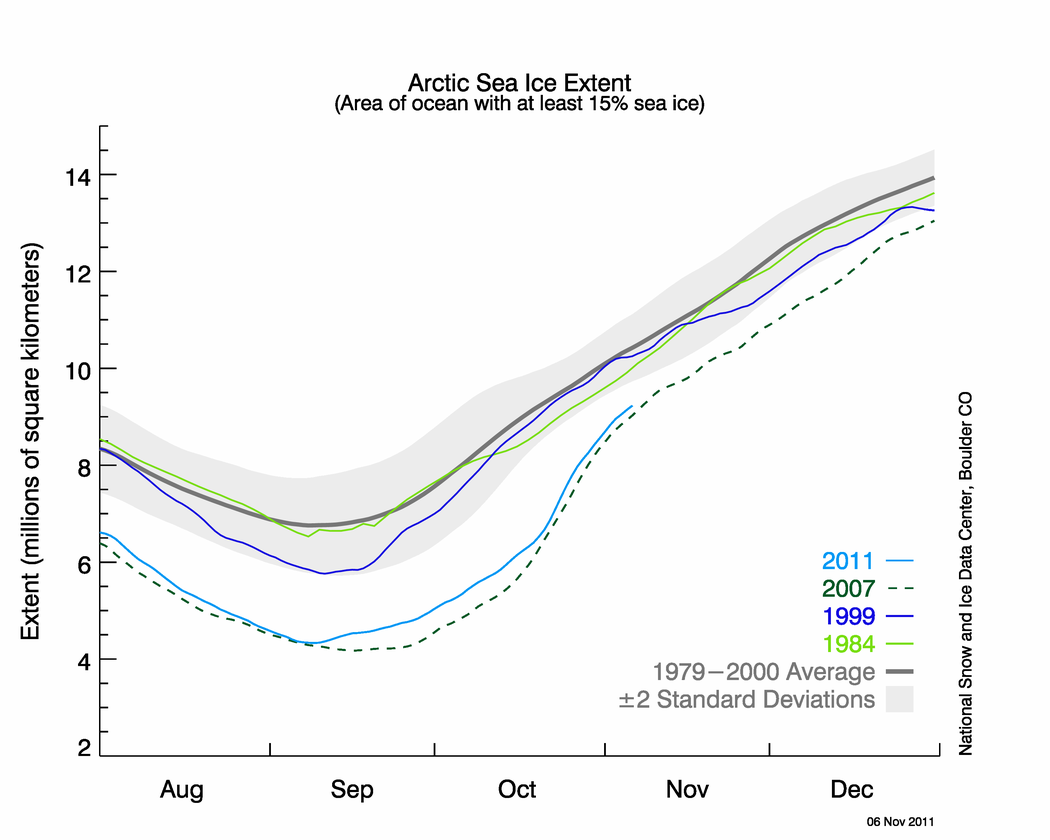
I started the blog off talking about the record low sea-ice extents seen in the Arctic in recent decades, showing a graph of this years data against 'record low' years. It was clear that 2011 experienced the second lowest ice extent in the satellite record, just beaten by the record-breaking 2007 year with it's unusual weather patterns. As discussed, 2011 did not experience 'unusual' weather as in 2007 around the Arctic, making the almost record concerning. I know you haven't been able to sleep since because of it, so I thought I'd give an update as has been recently published.
http://nsidc.org/images/arcticseaicenews/20111102_Figure2.png
The good news is that the ice extent rapidly increased during the end of October, meaning it hasn't yet been lower than 2007. Despite this, it's still far lower than the 1979-2000 average, including 2 standard deviations. 'Record low' years for each decade are also shown, 1984 and 1999, which were lower than the average but nothing compared to the last few years. Just to illustrate the difference, the UK has an area of 243,610 Km squared, meaning the difference between 2011 and 1999 ice extent at the end of October is about 5-6 times the size of the UK. It's also about the same size as 1 Mongolia, 75 Wales(s), 9,375 Liechtensteins and 3,000,000 Vatican Citys (don't say I don't help you out).

To keep up to date and save you those sleepless nights you can keep checking for updates on sea-ice extent here.

Monday, 21 November 2011

Arctic Lakes and Zoological Indicators

As we saw in the last post, it is highly likely that climate is indirectly altering Diatom communities in high Arctic lakes through changing levels and patterns of ice cover. Quinlan et al. (2005) used the same cores as the (previously reviewed) Douglas et al. (1994) study and counted the fossil chironomid (non-biting midge) larvae remains down the cores to investigate whether invertebrate communities have also 'shifted', and if they have, how likely it is that the changes are linked to the results from the previous diatom investigations. It's important to note, however, that these results are only taken from three archives (ie lakes and ponds) from Ellesmere island so further study is required to confirm that these findings are widespread.

Chironomidae are a family of flies which are aquatic organisms until their adult stages (see above) and

Sunday, 20 November 2011

Arctic Lakes and Diatom Change - A Brief Summary

As promised, I'm going to cover the Smol et al (2005) article this time, as well as some associated references which will form part of the discussion. This post will focus on the Diatom changes seen in a wide range of Arctic lakes and their inferred causation. It's generally accepted that the Arctic regions will experience the effects of climate change disproportionately to other regions. This, coupled with the sensitivity of Arctic lakes, (potentially) makes this form of study an early indicator of the speed and severity of climate change in the future on a global scale. (Oops, I may have partly answered the final question). Oh well, on with the post...

A subarctic lake from Northern Quebec
Arctic Lake ecology is nice summarised by Smol and Douglas (2007) and shows that

Friday, 18 November 2011

Thresholds and tipping points? - Arctic lake 'regime shifts'

For the next post I'm going to be reviewing an article by Smol et al (2005) entitled "Climate-driven regime shifts in the biological communities of Arctic lakes". So before I launch into that, I thought it would be best to have a review of the ecological theory surrounding what they are calling 'regime shifts' by looking at the article they reference. Ecological shifts can occur naturally (such as through fires) or, as is more likely in recent times, due to human activities. Click 'Read more' for a proper explanation...
Conceptual diagram of regime shifts and alternative
stable states. Direct from Scheffer et al (2001)

Monday, 14 November 2011

Using Quartz as an Ice Rafted Debris (IRD) record

In addition to IP25, Axford et al 2011 (as mentioned in the previous post) also tested the presence of Quartz in marine cores as a proxy for ice rafting in the North Atlantic. Both of these proxies allow a reconstruction of ice abundance in the Northern Atlantic regions. Unlike IP25, however, Quartz is not a biological proxy, rather it is sometimes present as a 'foreign' material assumed to have been transported by floating ice (icebergs). Click 'Read more...' for a short summary of the method and a couple of examples.