 |
| A subarctic lake from Northern Quebec |
Showing posts with label ice. Show all posts
Showing posts with label ice. Show all posts
Sunday, 20 November 2011
Arctic Lakes and Diatom Change - A Brief Summary
As promised, I'm going to cover the Smol et al (2005) article this time, as well as some associated references which will form part of the discussion. This post will focus on the Diatom changes seen in a wide range of Arctic lakes and their inferred causation. It's generally accepted that the Arctic regions will experience the effects of climate change disproportionately to other regions. This, coupled with the sensitivity of Arctic lakes, (potentially) makes this form of study an early indicator of the speed and severity of climate change in the future on a global scale. (Oops, I may have partly answered the final question). Oh well, on with the post...
Arctic Lake ecology is nice summarised by Smol and Douglas (2007) and shows that

Wednesday, 9 November 2011
The C25 HBI Monoene AKA "IP25" biomarker in marine sediment cores - a valuable contribution?
I know at the end of the last post I promised a move away from palaeoclimate studies to ecosystem change, but there's a couple of subjects I've recently come across that I thought would be interesting to consider before moving on (sorry!). The first one is the use of IP25
 |
| Skeletal formula of the IP25 biomarker |
Monday, 17 October 2011
Out of sight, out of mind?
Last month (Sept 2011) marked the end of the summer maximum in the northern hemisphere, and the total sea ice extent change data is beginning to emerge. This year’s summer extent was on a par with the record low of 2007 (since satellite records began in 1979) despite weather conditions being less favourable to sea ice loss than in that year. The National Snow and Ice Data Centre (NSIDC) remote sensing records on sea ice extent for the past few years are shown below:

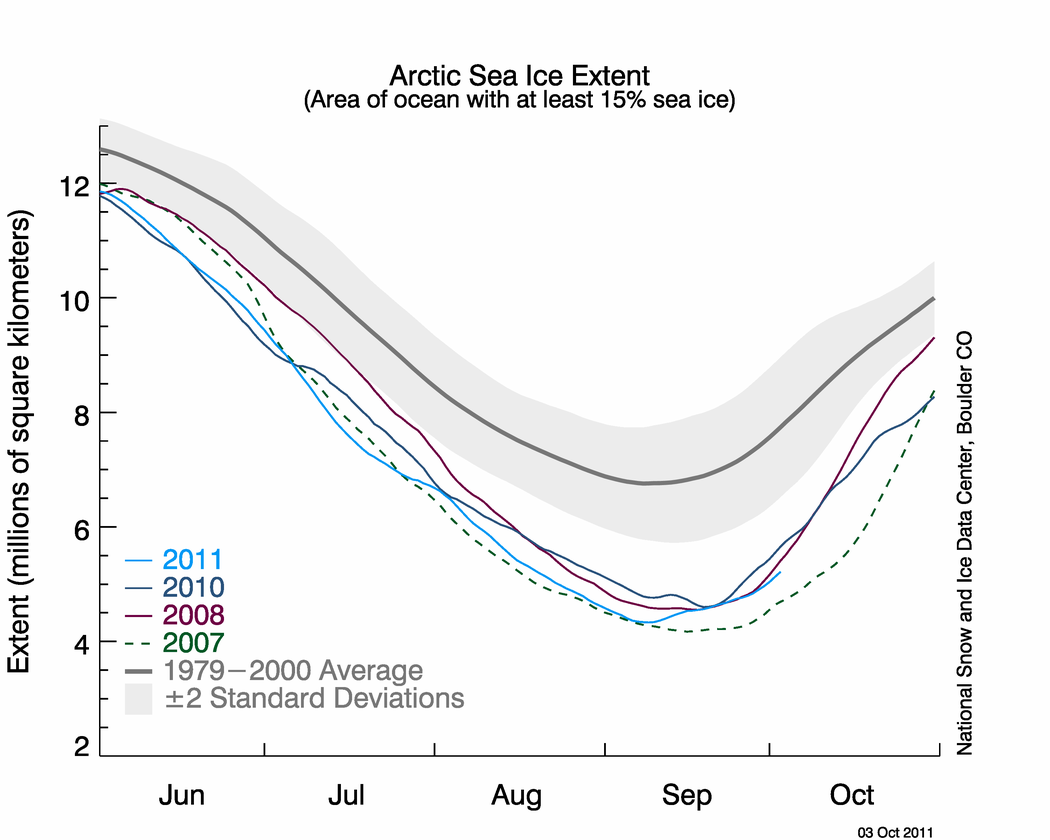
It is clear from this that recent summer, and to a lesser extent, winter ice extent is far below the average of the past 30 years plus two standard deviations. It could be said then, that the ‘climate’ of sea ice in the region is changing.
Overall, the far north is changing faster than almost anywhere else on earth. For this reason, it is likely that the arctic region is going to give the best warning signs as to the rate and severity of global climatic change. I will try in this blog over the coming months to engage with (and hopefully come to some conclusions about) important questions surrounding the change in the arctic regions, namely:
How do we know the sea ice retreat registered by satellite data in the past c.30 years is unusual?
Are any changes apparent in terrestrial and aquatic arctic ecosystems?
Is anything else apart from rising temperatures causing change?
Is anything else apart from rising temperatures causing change?
What is the likely impact of future human activity on marine and terrestrial arctic ecosystems?
Will changes in the Arctic have an effect on the global climate?
What has this got to do with me? Should I be worried?
What has this got to do with me? Should I be worried?
Even if you have no interest in the environment (but if you’re reading this I’d expect, and indeed hope that you are) the changes facing the arctic regions are likely to have severe economic, cultural and (geo)political impacts. Although a ‘cold’ war is unlikely (despite scare stories in the media), human activities such as patterns of transport and resource use are likely to be affected. Indeed, geopolitical wrangling has been going on for some time (eg Russian flag planting mission).
The aim of this blog is not to discuss solutions to rising CO2 emissions and climate change, but rather to see how arctic ecosystems have been and continue to be changed by climate changes and occasionally give examples of how this is likely to affect human activities. This will be done by discussing studies on past change, current measurements and future predictions.
Please feel free to disagree, argue with or debate anything I’ve written (as long as they’re at least mildly constructive!) by commenting.
Subscribe to:
Posts (Atom)